Monday, January 31, 2011

More on Brewing Temperature

I see a lot of figures on brewing temperature. I was reading a post on tea happiness about brewing temperature, and that post referenced an older post about brewing temperature on World of Tea. Another page I found is TeaSource's page on Preparing Tea. I found myself wanting to quibble a bit with some of the advice presented on these pages (and virtually everywhere). I of course maintain RateTea's page on Brewing Tea.

My main quibble is that I think people overemphasize exact temperatures, and underestimate personal taste preferences, experimentation, and the process of learning. I also think, at least compared to what I like, which is likely not what you like, is that I have found people tend to chronically under-estimate optimal brewing temperatures. On average, I like steeping it hot, although there's one exception that I'll mention below.
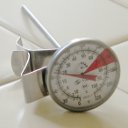


Yes, I have used a beverage thermometer to check my temperatures. But you do not need one if you just want to drink tea or brew it for others! The only reason that I bought (and use) this thermometer is so that I can get an objective read on temperature for sharing with others when I write reviews or post on this blog on on other sites.

Some Observations I've Made about Brewing Temperature:

Figures are given in Fahrenheit; a useful tool in case you're curious may be this Fahrenheit to Celsius Converter.
  • The temperature of the vessel you're pouring into is important in determining the brewing temperature: if you don't warm it up ahead of time, the water will immediately cool down as it enters the vessel.
  • Looking at the bubbles forming on the bottom of the pot or kettle can be a reliable way to assess temperature, but only after you've gotten to know each pot. I have two similar-looking Revereware pots, and one of them forms bubbles at a lower temperature than the other; I don't have a good understanding of why. This caused me to brew some green teas with water that was too hot, the first few times I used this pot to heat water. The bubble formation also depends on how I'm heating the pot--I had to relearn the bubbles as I moved and went from a gas to electric stove.
  • I find that people tend to underestimate the temperatures required for brewing tea properly, at least, according to my own tastes. I find that this is particularly true of white tea, which I tend to find less sensitive to high temperatures than green tea, but also true of green and oolong tea, and some Darjeeling black tea.
  • Green teas I find to be most sensitive to brewing temperatures, and, along with Darjeeling oolongs, the only teas that will ever be outright unpleasant if brewed with water that is too hot. But even then, there are some green teas that are drinkable when brewed with boiling water. One thing that I have read about that I have found rings true in my own experience is that Gyokuro demands lower-temperature water than other green tea. But I find that even with green teas, people's estimates for optimal temperatures seem to be on the low side. I think 160F for a typical green tea is too low, unless you want a very mild cup. 180F is the target I shoot for, but 160 for Gyokuro.
  • A lot of oolongs don't taste good to me unless you brew them with boiling or near-boiling water. A lot of sites recommend 190 or a range of 190-200. I think 190 is too low. This has even been true for me of many greener oolongs. Most oolongs, when I brew them at 190, strike me as bland. An exception are Darjeeling oolongs, which I find typically demand a lower temperature, often to the point of being unpleasant or even undrinkable if they're brewed with boiling water. With a Darjeeling oolong I aim for 160-180F for starters.


What happens when the temperature is "wrong" or "off"?

This varies hugely based on both the type of tea and the individual tea. Trends I've noticed:
  • Pan-fired green teas often become extremely harsh: bitter, sour, and astringent, if brewed with water that is too hot. The most sensitive teas in this arena have been the ones with a smoky aroma (strong or slight), such as chun mee or gunpowder. Of all the things that can go wrong based on brewing temperature, this one is the worst, as it often renders the cup undrinkable to me.
  • Steamed green teas often look different if brewed with water that is too hot. They often obtain an unpleasant "overcooked vegetable" aroma. In my opinion, compared to the pan-fired teas, they are more drinkable when they go wrong in this manner, but some can still be unpleasant or undrinkable.
  • Darjeeling oolongs become both harsh and obtain the overcooked vegetable aroma if brewed with water that is too hot. These teas can become highly undrinkable.
  • Black and oolong tea brewed with water that is too cool often seems very bland and with a weak, flat aroma. However, it's never undrinkable, just bland.
  • Some white tea can obtain the "overcooked vegetable" aroma if brewed with water that is too hot, but some can also be too bland if brewed with water that is too cool.
  • A few teas, including green, white, and some oolongs, lose some complexity to their aroma when the water is too hot, even if they do not acquire any unpleasant characteristics. I find that the teas for which this is the case are a tiny minority of the teas that are out there. More often, though, complexity is lost if the water is too cool--the reason to avoid hot water usually is that it results in unpleasant characteristics into the aroma or flavor that you would rather avoid.

What do you think? What are your experiences with brewing temperature? How do they agree with, or deviate from, the mainstream advice you find floating around out there?

Saturday, January 29, 2011

Can anyone help me identify this tea?

A while ago, one of my mom's students gave her a small packet of tea as a gift. It was outstanding. It was a tightly-rolled green-colored leaf (greener oolong or green tea? it was unlike any other oolong or green tea I've had) with an intense floral aroma, but one completely unlike anything I have tried since. I've had Dong Ding that very slightly hinted at the aroma of this tea, but nothing else has even reminded me of it. The tea was outstanding, and the powerful aroma lasted through many infusions, even when using a relatively small amount of leaf.

I saved the wrapper in the hopes that someone could help me to identify it and possibly locate it again or something similar. I finally got around to uploading the pictures of the wrapper. I would be grateful if anyone could share any insight into what, if any, information is on the label.

Here's the wrapper:


And the other side:


Thanks in advance for any insights!

Thursday, January 27, 2011

Aromas Inexplicably Popping Into Your Mind

A while back I wrote a post where do you notice that aroma?, in which I talk about priming and the recency effect, the phenomenon by which you are more likely to recognize sensations (including smells) that you've experienced recently: thus, if you ate a peach earlier in the day, you will be more likely to "find" a peach-like aroma in your tea.

Today, I'm writing about a closely related phenomenon: when you've tried something, and, rather than finding a similar-smelling aroma somewhere in your physical environment, you experience a vivid memory of that aroma, in the absence of any clear physical stimulus.

Why do I have a picture of the liberty bell?


I chose a bell to illustrate this phenomenon for the simple reason that, for me at least, a bell is a prime example of a sensory stimulus that remains vividly in memory. Bells are meant to have this effect: they are used to announce the passage of time, or the commencement of an event or gathering, and there is something about the ringing of the bell that makes a person stop and focus on it. I often am able to hear a bell ringing vividly in my mind well after it stops ringing, in contrast to other sounds which are more fleeting in my memory.

Yesterday, I experienced this phenomenon a while after drinking a cup of Rishi Tea's Jade Cloud, which is a green tea I enjoy very much. The tea had long since cleared my palate, and in fact, I had even drunk a cup of chamomile since then. And yet, staring out the window, the aroma of the Jade cloud inexplicably popped back into my mind, vividly, like I had just taken a sip. Why does this happen? I don't know. But I find it fascinating.

A theory about why this happens:

I've noticed that this phenomenon seems to have a limited time-window in which it occurs. It seems to happen most within a range of a few hours after drinking something, and rarely happens more than a day later. Is this an artifact of the way the brain forms memories? Or could there perhaps be a biological purpose for this phenomenon?

One thing that I think about a lot is the process of developing and changing our taste preferences based on our experiences with eating different foods and drinking different beverages. The natural environment that humans are adapted to live in is one in which there are many strange, poisonous substances. But being open to locate and identify new food sources, as well as helpful medicinal plants, would have a clear survival advantage. I have a theory that this phenomenon of aromas popping into our head is actually part of an innate mechanism which helps us to not only identify new food sources, but identify different medicinal plants, and to some degree, identify their function as well.

We often have a natural aversion to new tastes, but warm up to them slowly as we try new substances and feel good after eating them. Perhaps this phenomenon of aromas popping into the head is a way for the brain to check in and connect the aroma of the food or drink to the way we feel, forming an association between the outcome (the state of our body) and the possible cause (the new, unfamiliar substance we've recently consumed).

If we feel nauseous or out of balance, the brain will make a note and we may feel nauseous next time we encounter that aroma. If we feel any other way, such as peaceful, alert, thirsty, hungry, or some other way, the brain will note this as well. Then, when later presented with the substance, we would receive a signal from our brains about how we could expect to feel after eating or drinking it. As such, our brains would have the remarkable capacity to develop the ability for us to seek out food, drink, and substances that keep our body in balance.

This is just a theory. But it fits with everything I have experienced in my life, and with a lot of things that I know about science. What do you think? Is it too far-fetched? Or do you think there's something in this idea?

Tuesday, January 25, 2011

Your Response to Caffeine

A lot of health websites have data about caffeine. I particularly like one page that the Mayo clinic has, about how much caffeine is too much; their guidelines are that 200-300mg of caffeine aren't harmful for most people, but more than 500-600mg can negatively effect health. But they also remark: Some people are more sensitive to caffeine than are others., and also that How you react to caffeine may be determined in part by how much caffeine you're used to drinking.

This difference is due in large part to the fact that the body develops a tolerance for caffeine. But sensitivity to caffeine is also influenced by other factors, including sex, age, body mass, stress level, and other drug use.

From talking to my friends, I've seen a wide variety of responses to caffeine. Some people say it has little to no effect on them; other people find it really helps them concentrate, and they say they need it to get going in the morning. Some people avoid it because they find its effects unpleasant. Other people say they enjoy its effects but are able to function just fine without it.

How do I respond to caffeine?

My own response to caffeine is hard to generalize about because it is different on different days. In general, small amounts of caffeine tend to make me feel a little better: more focused, a little more positive and energetic. Too much caffeine can make me feel bad, though. Also, there are some ways where I respond very poorly to caffeine. If I'm a little tired, caffeine can perk me up, and if I'm a little hungry, it can stave off my hunger. But I've noticed that if I'm exhausted or ravenous, run down to a more extreme level, caffeine makes me feel terrible: it can make me feel even more sluggish, depressed, and just generally awful. Fortunately, I know these times now and I haven't had this problem for years because I avoid caffeine when I'm feeling tired or hungry beyond a certain threshold.

One reason that I prefer tea over coffee is that coffee has a bit too much caffeine for me. Coffee almost always makes me jittery, unless it's a weaker cup and I'm careful to drink it slowly (which results in lukewarm coffee, not the most pleasant thing). Tea, however, is gentler. Although the caffeine content of tea varies widely, it is almost always substantially more than tea. You can read more about how much caffeine is in various teas on RateTea's page about the caffeine content of tea.

The only problem I've had with too much caffeine from tea has been when I've been idly drinking cup after cup of tea in a Chinese restaurant, and I haven't been paying attention to how much I am drinking, and I have come out wired. Sometimes I also end up this way after tasting a bunch of teas, although I usually tend to space them out so this doesn't happen. But this feeling is usually not as unpleasant as the jitters I get from coffee, probably due to other chemicals in the tea.

I'm always able to function fine without caffeine. I'm a morning person and I wake up just fine, usually before my alarm on days when I have it set. My lowest point in the day is the late afternoon, and I often drink two or more cups of tea some time between noon and 6, so if there's any time of day when I have a noticeable caffeine addiction, it would be this time. But I wonder if it's really that or just that it's a natural low point in the day: I remember feeling this way from when I was a kid, long before I had any regular exposure to caffeine.

So, how do you respond to caffeine?

I would encourage you to either post comments or write your own blog post about caffeine. I think it is useful to see how different people respond to caffeine differently, and I'm curious to read what experiences others have.

Saturday, January 22, 2011

Does mood affect your tasting of tea?

I was inspired to think and write about this topic by Amy of a girl with tea, who recently wrote a post titled Bad Mood = Bad Tea?


When people brew the same tea twice and end up with a radical different experience drinking it, those who are scientifically and mechanically minded often tend to look for explanations in terms of more objective and more easily quantifiable factors, such as water temperature, amount of leaf used, steeping time, and for the more nuanced among us, finer details of water quality or the type of vessel used to brew the tea. Yet another level of subtlety is to consider the size and shape of the vessel we drink from, which influences our perception of aroma as it changes how the smells rise from the cup, and also our perception of flavor as it can influence the heterogeneous distribution of various chemicals in different layers in the cup (for example, I notice that when drinking from a tall mug, certain flavors sink to the bottom of the cup).

But are these factors the biggest factors influencing our tasting experience? There are some teas where subtle differences in brewing temperature or steeping times can lead to major changes in how the tea tastes, but for the most part, the changes in taste affected by changes in these objective, external factors are relatively subtle. But there are some other factors that influence taste, and to find these, we need to look within, and at phenomena that are tougher to measure or pinpoint:

How does the state of our mind and body influence taste?

I've noticed that my taste perception is highly dependent not only on mood but on other factors within my own body. What I've eaten recently (even if the taste has long cleared my palate) and whether or not I'm hungry both influence my perception of taste in profound ways. My mood definitely influences my perception of taste, sometimes, like Amy pointed out, to the extreme of making a tea I would otherwise enjoy taste unpleasant or strange, if I'm in a bad mood. My mood is influenced by my environment and context, and especially, the company of whomever I'm with. I also notice that different teas taste different at different times of day.

There is actually solid science behind these seemingly crazy concepts. The Economist published an article a while back about how hormones influence perception of sweetness. Another article about taste published in The Independent explores how taste is influenced by factors as diverse as mood, hormones, lighting, association with various experiences, age, and genetics (and those are just a few of the topics touched on in that article).

There are many internal factors which influence taste, as well as external factors independent of the chemistry of the tea itself.

So, next time you wonder why a certain tea seems to taste different from the last time you brewed it, don't assume that this difference can be attributed to a difference in brewing. It may be your mood, hormones, company, the lighting, or some other factor that you can't even imagine.

Thursday, January 20, 2011

Identifying Robins as Individuals, by their Song

If you think this post is not about tea, please bear with me! It is, but you have to read a bit to get there.

Pictured below is a Robin surrounded by holly berries; this picture was taken in Delaware several winters ago, but there's a similar sight here every year, as flocks of robins converge on the holly trees, stripping them of their berries, which are a favorite fruit for these flocking birds.


Robin songs are highly structured. When I was a kid, I used to listen to them, and, being the musician that I was, I quickly identified structure and pattern in the song. A robin's song is made up of individual syllables. If you labelled them, you might hear trends like ABAACABDEAA...BBABACEEBAFG.... etc. The more I listened to robins, the more structure I heard. I realized that certain syllables would be shared and repeated between different birds, but often, each bird would have a subtly different voice. Furthermore, as I travelled, I started to hear regional accents. But for the most part, robins all sounded more or less similar, and I was hopeless actually telling one bird apart from another by its song.

One day, after years of listening to robins, I had this amazing epiphany. I was lying awake in bed, in the dark, in the wee hours of the morning, before the sun had risen, and the window was open. It was like something clicked in my brain. Suddenly, all robins sounded completely distinct, just like people's voices. They all sounded like individuals to me.

This is a gift that has persisted ever since this day (although I have yet to develop the ability to do this with any other bird species). I can now tell robins apart when they sing, and if I listen to a robin sing over a period of time, I will now come to recognize it by its song--often it just has to sing a few syllables for me to know which one it is, with certainty. This new skill has opened up a new landscape of perception to me. Robins use song, among other things, to peacefully (without physical confrontation) defend and negotiate territories. I now can hear when robins move to different territories, and I can figure out how many distinct territories there are surrounding my yard just by listening.

Listening to robins is like tasting tea:

It's just tea, right? How much variability is there? Or...maybe there's green tea and black tea, but all black teas taste the same. Right? It sounds crazy to a tea enthusiast, but to someone who has never tasted tea before, it's likely to be true.

The way the brain works is that we often start off with only the capability for crude discernment. By paying attention, we start to distinguish further nuances. We have that "Aha!" moment when we realize that we know what Darjeeling tastes like, or when we smell a cup of tea and know immediately that it is a pan-fired green tea, and have a good guess that it might be from Zhejiang province. We're all at different places on this road, and most of us are better at identifying certain classes of teas than others--undoubtedly, the ones that we enjoy most and are most familiar with.

But the point is, we get better at it. And in general, we get better at discerning objects of one class by exposing ourselves to and focusing on many different objects of that class. If you want to learn to tell apart Sencha from different regions in Japan, keep drinking Sencha from different regions, and keep paying attention to how it tastes.

This is why I like tea, and is one key reason that I pay a lot of attention to food in general.

It's definitely not the snobbery of connoisseurship that attracts me to the world of loose tea. I'm drawn in by the fact that becoming more knowledgeable about food hones the senses. Paying attention to the finer details of aroma and flavor is a process that stimulates the mind, helping you to develop new abilities of perception. I think this is a good general skill to have, as it's useful in virtually all aspects of life. And it's fun!

So, drink your tea and listen to how it tastes, listen to the birds, stop and smell the roses, pay attention to the nuances of people's body language while you people watch, look carefully at the weeds growing in your flower bed, listen to that background line you never noticed before in a familiar song, or find your own other way of experiencing this perceptual adventure. You never know where it is going to lead!

Tuesday, January 18, 2011

The Taste of Yunnan Province

I've read extensively about how the region in which a tea is grown influences its flavor, and as I've sampled more teas and honed my palate, I've begun to taste some of these distinctions, particularly the unique characteristics of tea from Darjeeling and nearby Himalayan regions, but also in other areas as well, such as Vietnam. Most other regional distinctions still elude me.

Today I became newly aware such a phenomenon when drinking a cup of Rishi Tea's China Breakfast, which is a Yunnan Red or Dian Hong, a black tea produced in China's Yunnan province, the same province famous for being the origin of Pu-erh. The location of Yunnan is highlighted on this map of China:


The cup of Rishi's China Breakfast that inspired me is pictured below:


I've drunk numerous cups of this particular tea, but today, I noticed something different about it. My brain somehow isolated and identified a particular component of the aroma, and recognized it as one familiar from Pu-erh teas, and that has been present in all Yunnan red/Dian Hong that I've tried, and one that I do not recall ever experiencing in any other teas, black or otherwise. Unfortunately, I can't find words to clearly articulate what this aroma smells like. It's a quality that I like, however, and one that I like when Pu-erh has more of.

If I had to grope in the dark for words to describe this quality, I'd say it is suggestive of incense and slightly of shitaake mushrooms, but not at all like the familiar button mushrooms.

Have you noticed any qualities like this, unique to Yunnan province, or any other tea-producing region, independent of the style or variety of tea? Are you able to articulate them at all? I'd be curious to hear different perspectives on this.